Force Feedback Teleoperation for Imitation Learning and Physical AI
Watch how it works
Collect human demonstrations with motion + force + interaction data ?As robots move beyond controlled laboratory environments and into complex, unstructured settings, visual perception alone is often insufficient for reliable physical interaction. Robots also need information about what happens when they touch, manipulate and interact with their environment.
“Our research in robotics is aimed at amplifying people rather than replacing them,” said Gill Pratt, Chief Scientist for Toyota Motor Corporation. “This new teaching technique is both very efficient and produces very high performing behaviors, enabling robots to much more effectively amplify people in many ways. Previous state-of-the-art techniques to teach robots new behaviors were slow, inconsistent, inefficient, and often limited to narrowly defined tasks performed in highly constrained environments.”
Source : https://pressroom.toyota.com/toyota-research-institute-unveils-breakthrough-in-teaching-robots-new-behaviors/
Why force-feedback teleoperation?
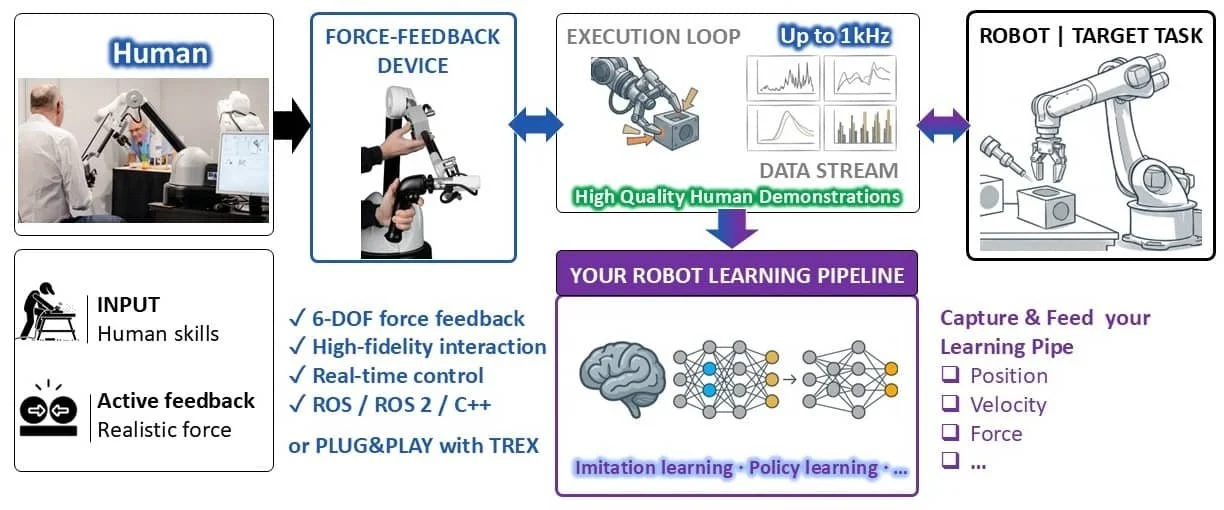
How to acquire real-world demonstration data through advanced teleoperation?
Example of setups
Standard Force-Feedback setup using Haption's standard ergonomic handle
Customer-specific handles, or haptic gloves
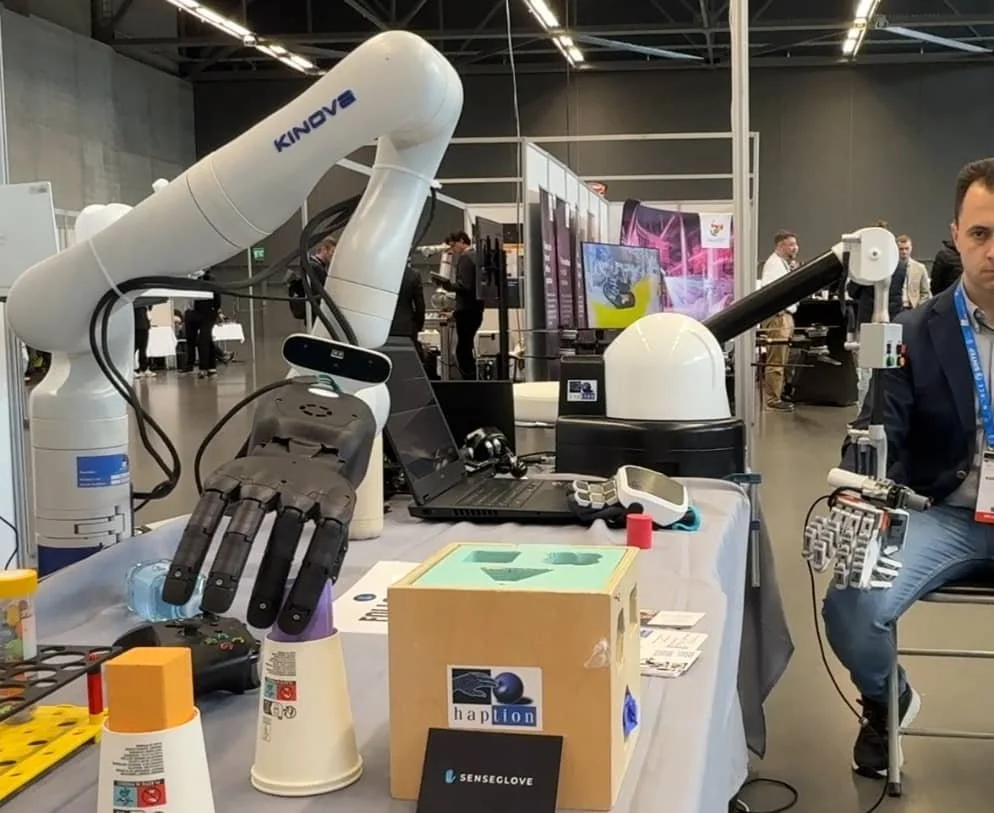
Single Arm + Glove
Source : Haption & SenseGlove at ICRA 2026
Dual Arms + Gloves for Bi-manual robotic setup
Source : IEEE telepresence | TNO
Humanoid setup
Source : https://www.i-botics.com/projects/xprize/
Virtual data setup
Source : Haption
How to build your own setup ?
CONFIGURATION #1. DIY
For robotics, haptics, and real-time control experts.
Maximum flexibility and customization (ROS2, ROS, C++, …)
Full control over algorithms and system performance
Ideal for pushing the performance to the limits
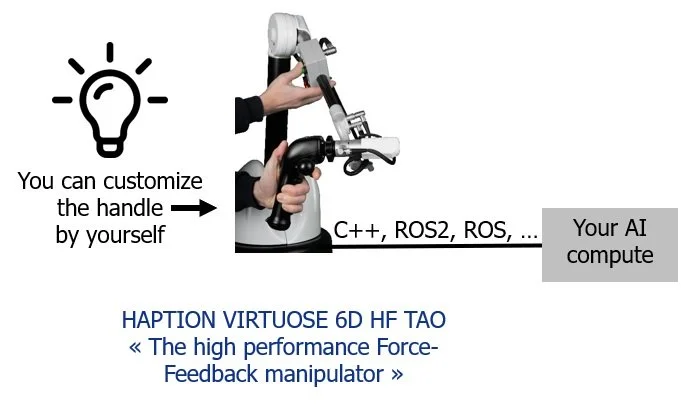
Illustration of the “DIY” configuration
CONFIGURATION #2. Plug & Play Standard or Customized
For AI, algorithm and real-time data collection experts.
Immediate access to real-time data : position, velocity, and force
Rapid deployment bundle with no complex integration
Ideal to focus immediately on your imitation learning pipeline
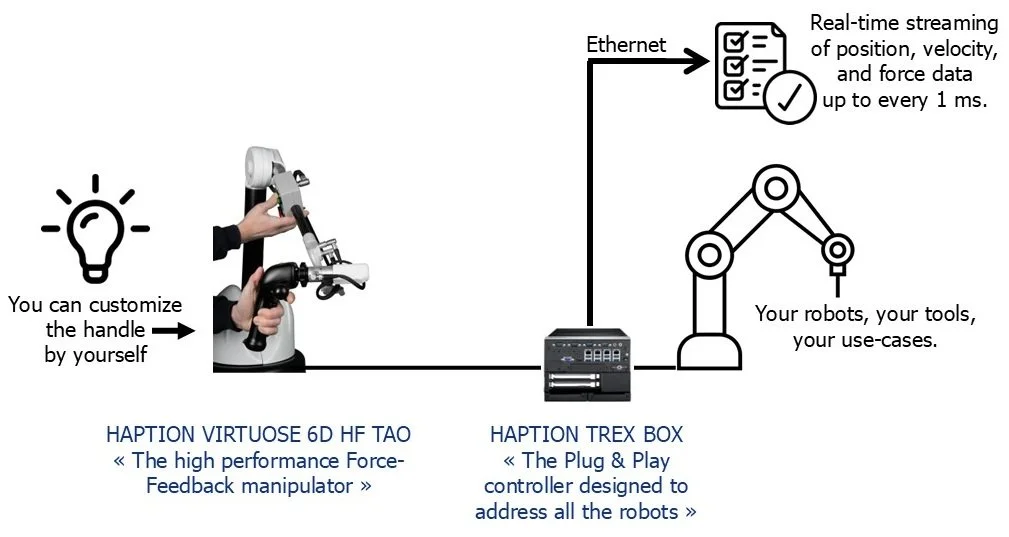
Illustration of the “Plug & Play” configuration using the TREX BOX
Adopt our technologies, accelerate your projects!
Partner Spotlight: SenseGlove
Our technology, combined with our partner’s haptic glove, creates a fully integrated haptic system that delivers a complete and immersive user experience.
By unifying tactile feedback at the hand with kinesthetic force feedback from the fingers to the shoulder, the system provides a continuous and realistic sense of physical interaction across the entire upper limb.
This unique architecture significantly reduces user fatigue by avoiding the burden of wearing heavy active devices on the hand alone, while ensuring natural and ergonomic operation over extended sessions.
Designed for seamless integration, the platform offers high-quality interoperability and native ROS 2 drivers, enabling rapid deployment within advanced teleoperation, imitation learning, and industrial robotics environments.
About SenseGlove : https://www.senseglove.com/project-rembrandt/
How does it work?
The solution is built around the standard VIRTUOSE TAO HF device from Haption, which serves as the grounded kinesthetic force-feedback interface of the system. When combined with the SenseGlove haptic glove, it creates a seamless interoperable haptic force-feedback environment using native ROS 2 drivers. The final integration into your specific system environment, whether for robotics or virtual reality applications, can then be carried out by your team according to your project requirements and use case.
You first need to purchase a VIRTUOSE TAO HF device from Haption. This device is fully compatible with the SenseGlove haptic glove through an integration solution provided by SenseGlove.
For greater convenience, it is also possible to purchase the bundle VIRTUOSE TAO HF + its haptic Glove directly from SenseGlove.
Partner Spotlight: Kinova
The Virtuose 6D HF TAO is certified by Kinova as a control interface for the Gen3 robotic arm, giving operators genuine bilateral control across a working volume large enough for fullarm teleoperation tasks.
About Kinova GEN3 : https://www.kinovarobotics.com/product/gen3-robots#ProductSpecsOverview
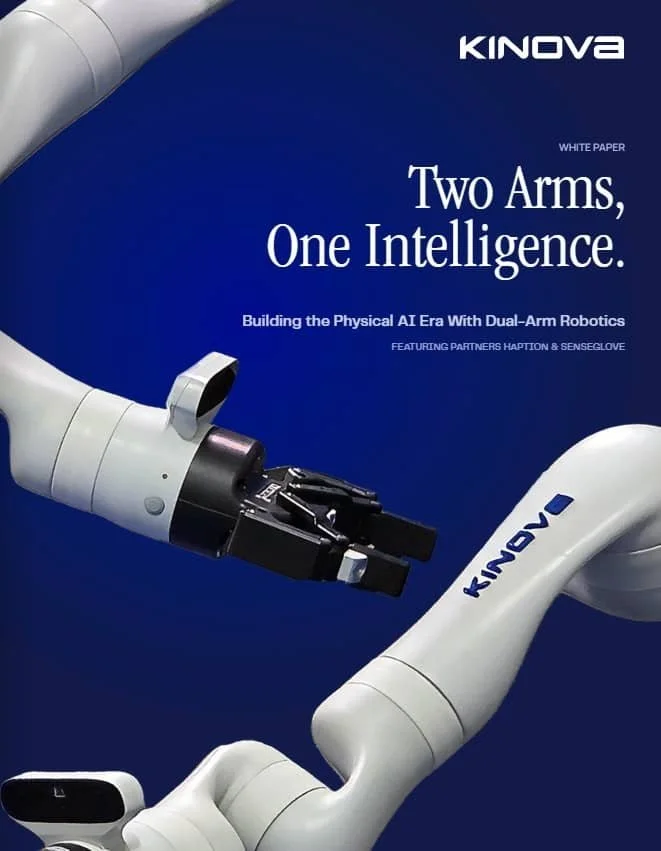
Bimanual Manipulation Is the Next Capability Frontier
Pairing two Kinova arms with two Haption controllers gives an operator true bilateral control. They don't just move each arm - they feel the resistance, contact, and weight each arm encounters. That force channel is what lets a human demonstrate delicate bimanual tasks, such as inserting a connector while the other hand stabilizes a housing, with the fidelity a physical AI model needs to actually learn contact-rich manipulation, not just trajectories.
If you want to learn more about where dual-arm physical AI is heading, check out the full paper here: https://loom.ly/HXPIj20
Force feedback provides an additional layer of information about physical interaction, including contact forces, resistance and mechanical constraints. Combined with visual, tactile and proprioceptive sensing, it can help robotic systems respond more effectively to contact-rich tasks, uncertainty and unexpected changes in their environment.
Force feedback is particularly valuable in haptic teleoperation, where operators interact with remote environments while receiving real-time information about physical contact. This can support precise manipulation and complex task execution, while also capturing valuable data about how humans interact with objects and apply forces during a task.
This capability is increasingly relevant to research in Physical AI, embodied intelligence and imitation learning. Training robots to perform real-world tasks requires more than trajectories and visual observations. Information about forces and physical interactions can provide additional context for understanding how an action is performed and how a robot should respond when conditions change.
Through haptic teleoperation, researchers can collect interaction data that combines motion, force and contact information. These datasets can support research in imitation learning, robot learning, manipulation and autonomous systems, helping to connect human demonstrations with the physical constraints of real-world tasks.
Force feedback can benefit both single-arm and dual-arm robotic systems. In single-arm applications, it can support delicate assembly, contact-rich manipulation and inspection by providing information about unexpected physical interactions. In dual-arm robotics, force and haptic information can contribute to coordinated bimanual manipulation, particularly when tasks involve shared loads, physical contact or interaction between multiple manipulators.
Force and interaction data are also relevant to digital twins and simulation-based robotics. By incorporating information about real-world physical interactions, researchers can develop more realistic models of contact and manipulation and address some of the challenges associated with transferring robotic skills from simulation to physical systems.
For autonomous robots, force feedback can complement visual and proprioceptive sensing by providing additional information about the physical consequences of an action. This multimodal approach can support the development of more adaptive control strategies and learning-based robotic behaviors.
In human-robot collaboration, information about forces and physical contact can also contribute to safer and more responsive interaction. Robots can use this information, alongside other sensing and control systems, to better adapt their behavior when interacting physically with humans.
As robotics research expands into manufacturing, aerospace, healthcare, nuclear operations and advanced research laboratories, understanding physical interaction will become increasingly important. At the intersection of robotics, haptics and Artificial Intelligence, force feedback is emerging as an important component of embodied and Physical AI.
By complementing vision and motion with information about physical interaction, force feedback can help robots move beyond observing their environment and toward interacting with it more reliably, adaptively and intelligently.

As Physical AI moves from research into real-world applications, access to high-quality data is becoming an important challenge. Robots must learn not only how to move, but also how to interact with the physical world. Motion and vision data provide part of this information, while force and haptic data can add valuable context about contact, resistance and physical constraints.
This is particularly relevant to research in embodied AI, imitation learning and learning from demonstration. Training robots for real-world manipulation often requires multimodal datasets combining vision, motion and force information. Such data can help researchers study how humans perform physical tasks and how robots can adapt their behaviour when interactions differ from expected conditions.
Haptic teleoperation offers a practical approach to collecting this type of interaction data. By recording human motion alongside real-time force information, researchers can capture demonstrations that include both actions and their physical consequences. These datasets can support research in robot learning, behavioural cloning, dexterous manipulation and autonomous robotics.
Force and haptic data can be relevant to both single-arm and dual-arm robotic systems. From delicate assembly and contact-rich manipulation to coordinated bimanual tasks, information about physical interaction can complement visual and motion data when robots must operate in complex or uncertain environments.
Haptic data can also contribute to research involving simulation-to-real transfer, digital twins and remote operation. Incorporating real-world interaction data can help improve models of contact and manipulation, while force feedback allows human operators to better perceive remote physical environments.
As investment in Physical AI and intelligent robotics continues to grow, access to diverse, high-quality multimodal datasets is likely to become increasingly important. By combining force feedback, haptic teleoperation, vision and motion data, researchers can develop richer representations of physical interaction and support the development of more capable, adaptive and reliable robotic systems.
The development of foundation models for robotics is opening new approaches to robot learning. Rather than being designed for a single predefined task, these models can learn from large and diverse datasets and aim to transfer knowledge across different tasks and environments.
Research in imitation learning, generative models and diffusion-based policies is contributing to this evolution. By learning from human demonstrations and large-scale interaction data, robots can acquire manipulation and control skills that may be adapted to new situations.
Multimodal approaches are particularly important in this context. Combining vision, language, motion and force information can provide a more complete representation of both a task and its physical constraints. While vision helps robots perceive their environment, force and haptic data provide additional information about contact and physical interaction.
Haptic teleoperation can play an important role in collecting this type of data. By combining human demonstrations with motion and force information, it can support the creation of datasets for robot learning, imitation learning and dexterous manipulation. This applies to both single-arm and dual-arm robotic systems, particularly in tasks involving physical contact, manipulation or coordination.
Foundation models for robotics are still an active area of research, and significant challenges remain in areas such as data quality, generalization, safety and real-world deployment. However, the combination of large-scale datasets, multimodal learning and physical interaction data is creating new opportunities for the development of more adaptable robotic systems.
Across manufacturing, healthcare, logistics, aerospace, nuclear applications and research, these approaches may help expand the range of tasks that robots can perform reliably in complex physical environments.
